Every year, hundreds of workers suffer serious injuries—or worse—because equipment energizes unexpectedly during maintenance. The root cause? Inconsistent or missing lockout tagout (LOTO) procedures. While OSHA’s standards are clear, implementation often fails at the execution level. That’s where a reliable, customizable lockout tagout procedures template becomes essential—not just for compliance, but for real-world safety.
A well-designed template isn’t a one-size-fits-all formality. It’s a living document that guides teams through identifying energy sources, isolating hazards, applying locks and tags, and verifying zero energy. More importantly, it standardizes actions across shifts, departments, and facilities. Without it, human error increases, accountability blurs, and protection erodes.
This guide delivers a robust LOTO procedures template framework—ready to adapt to any industrial environment—and walks through implementation best practices, common pitfalls, and real-use scenarios.
Why You Need a Lockout Tagout Procedures Template
Think of a maintenance technician stopping a conveyor system for a belt replacement. In a rush, they power down the controls but don’t lock out the motor disconnect. Another worker, unaware, restarts the system from a remote panel. The result: a potentially fatal entanglement.
This scenario isn’t rare. OSHA estimates that nearly 10% of serious accidents in manufacturing involve unexpected energization or startup of machinery. A standardized LOTO template prevents these tragedies by ensuring every step is documented, visible, and repeatable.
Templates eliminate guesswork. They turn procedural memory into written, enforced action. Beyond safety, they serve as: - Training tools for new employees - Audit trails during OSHA inspections - Legal protection in incident investigations - Process benchmarks for continuous improvement
Without a template, companies rely on verbal instructions, inconsistent practices, or outdated PDFs—none of which meet OSHA’s requirement for written energy control procedures (29 CFR 1910.147).
Core Elements of an Effective LOTO Procedures Template
A high-impact lockout tagout procedures template must be specific, actionable, and machine-focused. Generic checklists fail when applied across diverse equipment. Instead, each procedure should include these non-negotiable sections:
1. Equipment Identification
- Machine name and ID number
- Location (plant, floor, zone)
- Department or production line
Example: > Equipment: Hydraulic Press #7 > ID: HP-2241 > Location: East Wing, Assembly Line B
This prevents confusion in facilities with multiple similar machines.
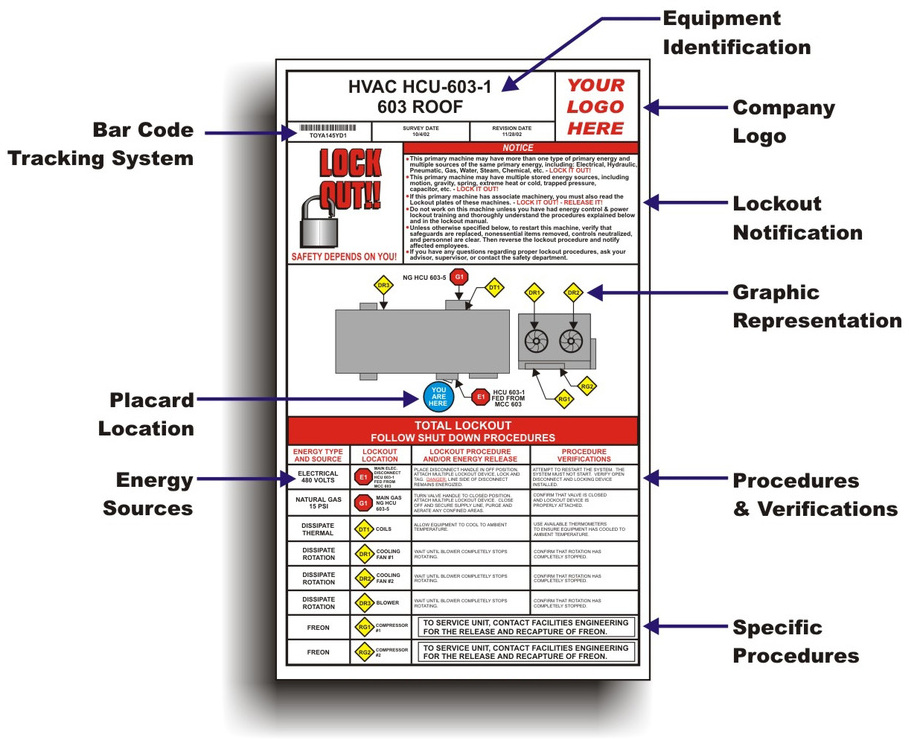
2. Energy Source Identification List every energy type present:
- Electrical (voltage level)
- Pneumatic or hydraulic pressure
- Gravitational (e.g., elevated parts)
- Chemical (residual gases, fluids)
- Thermal (heat retention)
Common Mistake: Overlooking stored energy. A press may be electrically off, but hydraulic lines could still hold pressure capable of crushing limbs.
3. Shutdown Steps Step-by-step actions to safely power down:
- Notify affected employees
- Stop machine via control panel
- Place controls in “Off” position
- Isolate auxiliary systems (e.g., cooling pumps)
Use active, imperative language: “Press E-stop button. Confirm all motion has ceased.”
4. Isolation and Lock Application Detail exactly where to apply locks:
- Main disconnect switch
- Valve isolation points
- Circuit breaker panels
Include lock type (e.g., hasp, valve lockout, breaker lock)
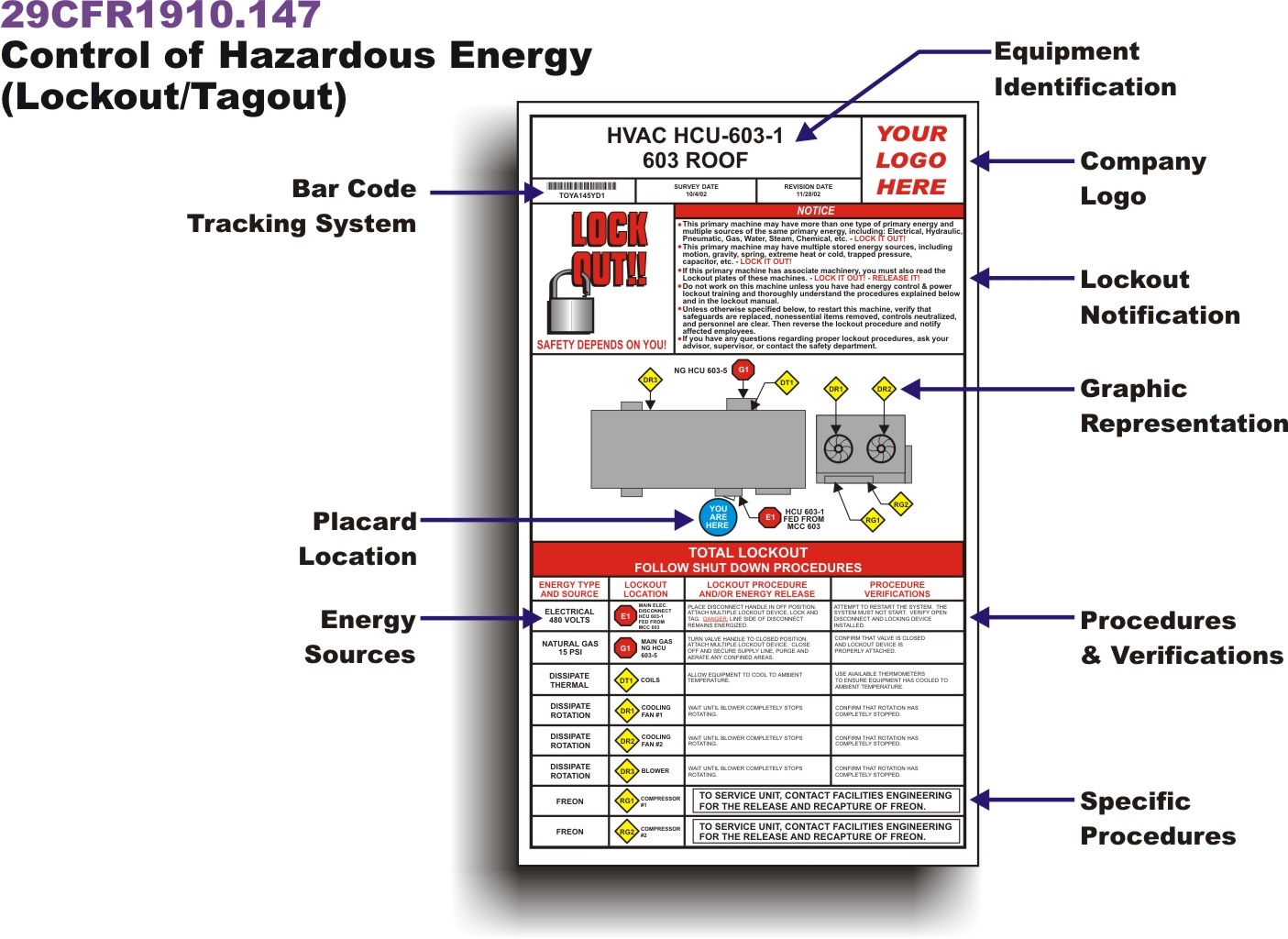
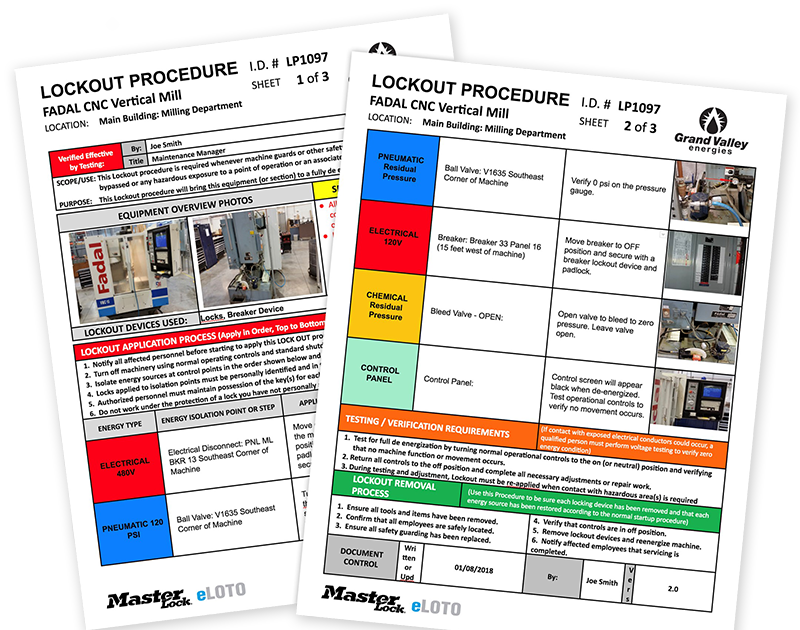
Tip: Use diagrams or photos in the template for clarity—especially with complex machinery.
5. Tagout Application Tags must include:
- Name of authorized employee
- Date and time of lock application
- Reason for lockout
- Contact information
Tags are warnings; locks are physical barriers. Both are required.
6. Energy Dissipation and Verification Document how to safely release stored energy:
- Bleed hydraulic lines
- Ground capacitors
- Block or secure suspended parts
Then, test for zero energy: > “Attempt to restart machine using normal controls. Confirm no motion or power. Return controls to ‘Off’.”
Verification is the most critical—and often skipped—step.
7. Restoration Procedure Outline return-to-service steps:
- Confirm work is complete
- Remove tools and guards
- Notify all employees
- Remove locks only by the person who applied them
- Restart in controlled sequence
Never allow group lockout removal without verifying individual clearance.
Real-World Use Case: Applying the Template in a Packaging Plant
Consider a packaging facility with a case sealer that uses electrical power and pneumatic actuators. Maintenance is scheduled to replace worn rollers.
- Template in Action:
- Identify: Case Sealer #3, Packaging Line 1
- Energy Sources: 480V electrical, 90 PSI air lines
- Shutdown: Operator presses E-stop, confirms belt stops
- Isolate: Lock out main disconnect (electrical panel B3), close and lock air shutoff valve
- Tag: Apply tag with technician name, date, “Roller replacement in progress”
- Dissipate: Open vent valve on air line, confirm pressure gauge reads zero
- Verify: Try restart—no response. Safe to proceed.
After work: - Technician inspects area, removes tools - Confirms no one is near machine - Removes personal lock and tag - Restarts system under supervision
This procedure, documented and followed, prevents a hazardous startup. Without the template, the technician might forget to bleed air—a hidden energy source that could cause sudden movement.
Common Mistakes That Undermine LOTO Procedures
Even with a solid template, failures occur due to poor implementation:
- Using the template as a one-time document
- Procedures must be reviewed annually and updated after equipment changes.
- Skipping verification
- Assuming a machine is de-energized without testing is a top cause of incidents.
- Allowing lock sharing or group overrides
- Each worker must apply their own lock. No exceptions.
- Failing to train affected employees
- Not just authorized lockout personnel—everyone who works near the equipment must understand the tags and barriers.
- Poor template accessibility
- If the LOTO procedure is buried in a shared drive, it won’t be used. Print copies near equipment or use digital tablets on the floor.
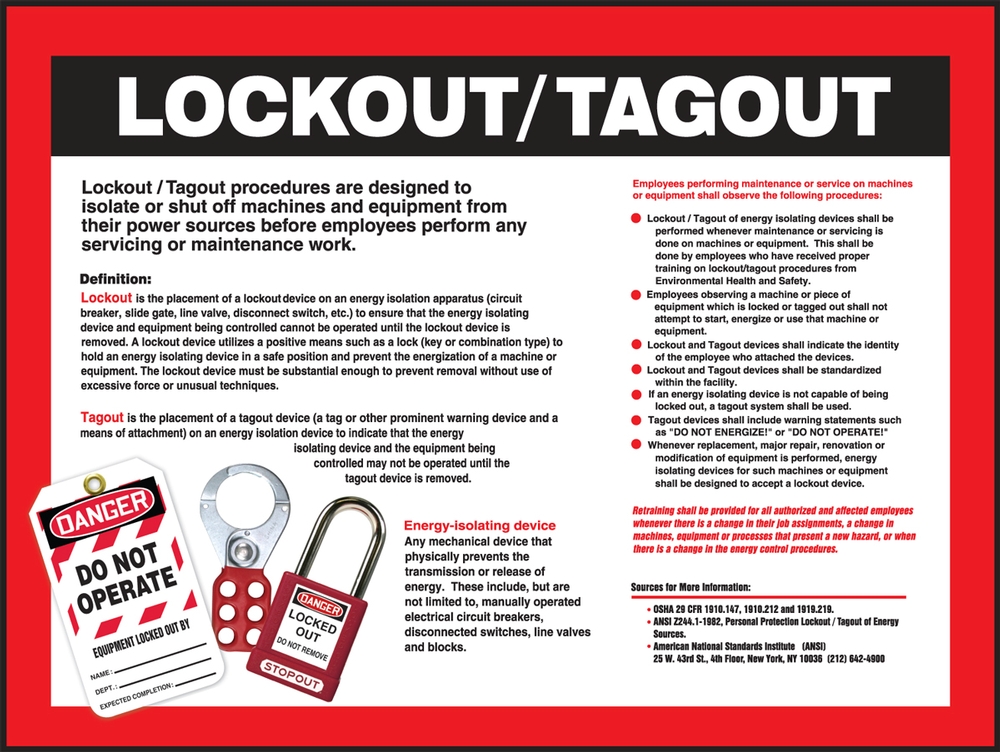
One auto parts plant reduced LOTO incidents by 70% simply by posting laminated procedures at each machine station—proving that visibility drives compliance.
Free & Customizable LOTO Procedures Template (Download Ready)
Below is a universal template structure you can adapt for any machine. Copy this into Word, Google Docs, or your EHS platform:
LOCKOUT TAGOUT PROCEDURE
Equipment: [Name and ID] Location: [Building, Floor, Line] Prepared By: [Name, Date] Reviewed: [Annual review date]
- ENERGY SOURCES
- - Electrical: [Voltage, Panel ID]
- - Pneumatic: [PSI, Valve Location]
- - Other: [List stored energy types]
- SHUTDOWN STEPS
- Notify affected personnel.
- Stop machine using E-stop.
- Place controls in “Off” position.
- ISOLATION POINTS
- - Lock main disconnect: [Panel B5]
- - Lock air shutoff: [Valve V-12]
- APPLY LOCKS AND TAGS
- - Use personal lock and tag at each point.
- - Tag must include: Name, Date, Reason.
- RELEASE STORED ENERGY
- - Bleed air lines via vent valve.
- - Confirm pressure gauge reads 0 PSI.
- VERIFY ZERO ENERGY
- - Attempt restart. Confirm no response.
- - Return controls to “Off.”
- RESTORATION
- - Confirm work complete, area clear.
- - Remove locks only by original user.
- - Notify team before restart.
Customize this for each piece of equipment. Add photos, QR codes, or safety warnings as needed.
Digital Tools to Enhance Your LOTO Procedures
While paper templates work, digital systems reduce errors and improve traceability. Consider these platforms to scale your LOTO program:
| Tool | Key Feature | Best For |
|---|---|---|
| EHS Insight | Mobile LOTO checklists, audit trails | Mid to large manufacturers |
| Fragkman LOTO App | QR-code-based procedures, real-time alerts | Facilities with high equipment turnover |
| SpheraCloud EHS | Integrates LOTO with risk assessments | Enterprise-level compliance |
| Lockout-Tagout.com Templates | Pre-built, OSHA-aligned PDFs | Small businesses on a budget |
| Fiix by Schneider Electric | CMMS with embedded LOTO workflows | Teams already using maintenance software |
These tools let you attach templates to assets, track lock durations, and generate compliance reports—turning static documents into dynamic safety controls.
Final Steps: Implementing Your LOTO Template System
Creating a template is only step one. To make it effective: - Assign ownership: One safety officer should manage updates. - Train both authorized and affected employees quarterly. - Conduct surprise audits—watch someone perform a real lockout. - Review procedures after any near-miss or equipment modification.
A template isn’t a compliance checkbox. It’s a behavior-shaping tool. When every technician follows the same verified steps, safety becomes automatic.
Start by selecting three high-risk machines. Build procedures using the template above. Test them in real maintenance cycles. Refine. Then scale.
Your goal isn’t just a document—it’s a culture where no one touches a machine without verifying it’s locked out.
Frequently Asked Questions
What is a lockout tagout procedures template? A standardized document that outlines step-by-step actions to safely de-energize and service machinery, ensuring compliance and worker protection.
Do all machines need a LOTO procedure? Yes, if they have potentially hazardous energy sources and require servicing under OSHA 1910.147.
Can I use a generic template for multiple machines? No. Each machine requires a unique procedure due to different energy sources and isolation points.
Who should use the LOTO template? Authorized employees performing service or maintenance, plus supervisors overseeing the process.
How often should LOTO procedures be reviewed? At least annually, or whenever equipment, processes, or staff change.
Are electronic LOTO templates compliant? Yes, if they are accessible to workers, tamper-proof, and include all required elements.
Can a tag alone be used without a lock? Only if a lock is not physically possible—and only with a documented justification and alternative protection.
FAQ
What should you look for in Lockout Tagout Procedures Template: Build a Safer Workplace? Focus on relevance, practical value, and how well the solution matches real user intent.
Is Lockout Tagout Procedures Template: Build a Safer Workplace suitable for beginners? That depends on the workflow, but a clear step-by-step approach usually makes it easier to start.
How do you compare options around Lockout Tagout Procedures Template: Build a Safer Workplace? Compare features, trust signals, limitations, pricing, and ease of implementation.
What mistakes should you avoid? Avoid generic choices, weak validation, and decisions based only on marketing claims.
What is the next best step? Shortlist the most relevant options, validate them quickly, and refine from real-world results.