Every year, dozens of workers are injured or killed during equipment maintenance because proper lockout tagout (LOTO) procedures weren’t followed. The root cause? Often, no clear, documented process exists — or worse, one exists but isn’t accessible where it’s needed most. That’s why a comprehensive, downloadable lockout tagout policy PDF isn’t just administrative paperwork. It’s a frontline defense against electrocution, amputations, and unexpected machine startup.
A well-structured LOTO policy PDF does more than satisfy OSHA auditors. It becomes the single source of truth for maintenance crews, safety officers, and operations managers. It standardizes procedures, reduces confusion, and ensures every employee follows the exact same protocol — every time.
If your workplace handles energized equipment, hydraulics, pneumatics, or stored energy systems, you need a clear, actionable LOTO policy — and you need it in a format that’s easy to distribute, train with, and reference.
What Belongs in a Lockout Tagout Policy PDF
A useful LOTO policy PDF isn’t a generic template pasted from a blog. It’s a site-specific, actionable document that answers critical questions:
- Who is authorized to perform lockout procedures?
- What machines or systems require LOTO?
- How are energy sources identified and isolated?
- What steps define the lockout sequence?
- How are tags and locks managed?
- What’s the process for shift changes or group lockouts?
Core Components of a LOTO Policy PDF
| Section | Purpose |
|---|---|
| Policy Statement | Declares the organization’s commitment to LOTO compliance and employee safety |
| Scope & Application | Defines which equipment, departments, and personnel are covered |
| Roles & Responsibilities | Lists who can lockout (authorized employees) vs. who must stay clear (affected employees) |
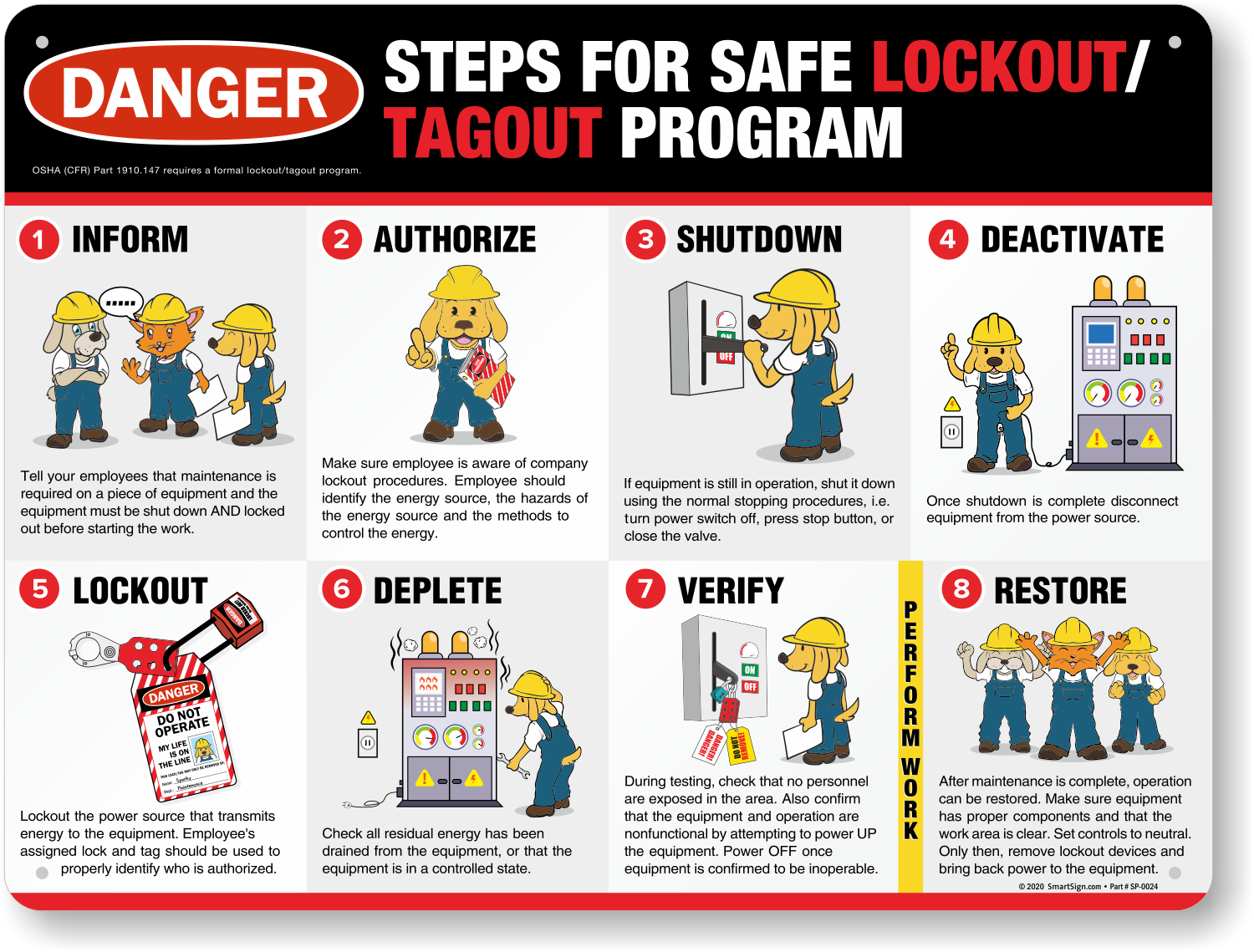
| Lockout Procedure Steps | Clear 6–8 step process: shutdown, isolation, lockout, verification, release |
| Equipment List | Inventory of machines requiring LOTO with unique IDs |
| Lockout Devices | Description of locks, tags, hasps, valve covers, and storage |
| Training Requirements | Frequency and content of employee training |
| Audit & Compliance | How often procedures are reviewed and tested |
Skip any of these, and your LOTO PDF becomes a liability in an audit — or worse, during an incident investigation.
OSHA Requirements and the Role of Your LOTO PDF
OSHA standard 29 CFR 1910.147 is the backbone of lockout tagout enforcement. It doesn’t mandate a PDF — but it does require a documented, written energy control program. A PDF is the most practical way to meet that requirement.
Key OSHA Mandates Embedded in a Strong LOTO Policy PDF
- Written procedures for each piece of equipment requiring maintenance
- Annual inspections of all LOTO procedures
- Training and retraining for both authorized and affected employees
- Specific identification of energy sources (electrical, hydraulic, chemical, etc.)
- Verification of zero energy before work begins
Your LOTO policy PDF must reflect these requirements verbatim — not in legalese, but in clear, step-by-step language your maintenance team can follow with gloves on and noise in the background.
"We had a full LOTO policy, but it was buried in a binder on the third floor. When a mechanic got hurt during a conveyor repair, OSHA asked to see it. We couldn’t produce it in under 20 minutes. That cost us $48K." — Plant Manager, Ohio manufacturing facility
Moral: Accessibility matters. A PDF stored on a shared drive and printed at each workstation is infinitely more valuable than a “compliant” document no one can find.
Real-World Use Cases for a LOTO Policy PDF
A PDF isn’t just for OSHA. It’s a tool used daily across industries.
1. Manufacturing Floor Maintenance
A press operator reports a jam in a hydraulic stamping machine. The maintenance technician pulls up the LOTO PDF on a tablet at the workstation, follows the machine-specific procedure, applies their personal lock, verifies zero energy, and clears the jam safely.
2. Shift Changeovers
An electrician begins isolating a motor control panel during day shift. The night crew takes over. The LOTO PDF includes a group lockout log, showing who applied each lock and why. No assumptions. No shortcuts.
3. Contractor Onboarding
A third-party HVAC technician arrives to service a chiller. Before work begins, they’re handed a printed LOTO policy PDF and required to review the site-specific procedures. Their supervisor signs an acknowledgment — stored digitally with the PDF.
4. New Employee Training
During onboarding, trainees are given the LOTO policy PDF as part of safety orientation. They walk through the document with a supervisor, answering comprehension questions before being cleared for floor access.
In each case, the PDF is not passive. It’s active, referenced, and enforced.
Common Mistakes That Undermine Your LOTO Policy PDF
Even well-meaning companies sabotage their LOTO efforts with preventable errors.
❌ Using a Generic Template Without Customization
Downloaded a free LOTO PDF online and slapped your company name on it? That won’t pass OSHA scrutiny. Your policy must match your machines, layout, and workforce.
Fix: Conduct a full equipment audit. Map every energy source. Tailor each procedure.
❌ Failing to Update After Equipment Changes
Added a new CNC machine? Modified a conveyor line? If your LOTO PDF doesn’t reflect it, you’re operating in violation.
Fix: Assign ownership — usually the safety manager or lead engineer — to review and update the PDF quarterly.
❌ Poor Accessibility
If your PDF is password-protected, stored on a single desktop, or only available in English in a multilingual shop, you’ve created a compliance gap.
Fix: Print laminated copies near high-risk machines. Store the PDF on a shared server with no login required. Offer translations.
❌ Skipping Employee Sign-Off
Employees who haven’t acknowledged the policy in writing can’t be held accountable.
Fix: Include a signature page in the PDF. Require annual review and sign-off, digital or paper.
How to Create a Practical LOTO Policy PDF (Step-by-Step)
Creating a compliant, usable LOTO policy PDF takes less than a week if you follow this workflow.
Step 1: Assemble Your Team
Include: - Safety officer - Maintenance supervisor - Production lead - HR or training coordinator
Step 2: Inventory High-Risk Equipment
List all machines with: - Electrical inputs - Stored energy (springs, hydraulics) - Moving parts - Heat/pressure sources
Assign each a unique ID (e.g., “CONV-07”, “PRESS-03”).
Step 3: Map Energy Sources For each machine, identify:
- Electrical disconnects
- Hydraulic/pneumatic valves
- Gravity-fed components
- Capacitors or batteries
Step 4: Write Machine-Specific Procedures
- Use this format:
- Notify affected personnel
- Shut down equipment using normal stop controls
- Isolate all energy sources
- Apply personal lock and tag
- Release stored energy (bleed lines, block movement)
- Verify isolation (attempt to restart, check gauges)
- Perform maintenance
- Remove tools, re-energize only after clearance
Repeat for each machine.
Step 5: Compile and Format the PDF
Use a clean, professional layout: - Company logo - Table of contents - Machine-specific sections - Signature acknowledgment page - Revision history log
Export as a searchable PDF with bookmarks.
5 Free & Customizable LOTO Policy PDF Templates
While no template replaces site-specific procedures, these free resources provide strong foundations:
- OSHA.gov LOTO Guide
- - Official government resource with sample policy language
- - Best for: Regulatory alignment and definitions
- - Download: osha.gov/loto
- CDC NIOSH LOTO Toolkit
- - Includes checklists, training slides, and a sample PDF policy
- - Best for: Healthcare and lab environments
- - Search: "NIOSH Lockout Tagout Prevention Program"
- University of Michigan EHS Template
- - Academic-grade, well-structured policy PDF
- - Includes flowcharts and role definitions
- - Search: “UMich Lockout Tagout Program”
- SafetyInfo.com Premium Template (Free Tier)
- - Professional layout, editable Word → PDF
- - Strong section on group lockout and shift changes
- - Search: “SafetyInfo LOTO policy sample”
- Canadian Centre for Occupational Health and Safety (CCOHS)
- - Bilingual (EN/FR), highly detailed
- - Useful even for U.S. operations
- - Search: “CCOHS lockout tagout sample program”
Tip: Use these as reference, not final documents. Customize every line to your site.
Maintaining Compliance: Beyond the First PDF Draft
Your LOTO policy PDF isn’t “done” once it’s published. OSHA requires annual inspections — meaning every written procedure must be observed and verified at least once a year.
Audit Checklist for Your LOTO Policy PDF
- [ ] All equipment covered?
- [ ] Procedures followed exactly as written?
- [ ] Authorized employees using correct locks/tags?
- [ ] Zero-energy verification confirmed?
- [ ] Group lockout procedures tested?
- [ ] PDF updated within last 12 months?
After each audit, revise the PDF and reissue it to all personnel.
Also: Retrain employees whenever procedures change — not just annually.
Final Thoughts: Your LOTO Policy PDF Is a Lifeline
A lockout tagout policy PDF should never be an afterthought. It’s one of the most critical safety documents in any industrial or mechanical environment. When designed right, it’s clear, accessible, and impossible to ignore.
Don’t wait for an injury or an OSHA citation to act. Audit your current procedures. Customize a template. Put it in writing. Distribute the PDF. Train your people. And keep it updated.
Because the next time a technician reaches into a machine, the difference between life and serious injury might be a single page in a PDF.
Frequently Asked Questions
What is the OSHA standard for lockout tagout? OSHA 29 CFR 1910.147 outlines the Control of Hazardous Energy, requiring written procedures, employee training, and periodic inspections for equipment servicing.
Can a LOTO policy PDF be digital only? Yes, if it’s readily accessible at all workstations — such as on tablets, shared drives, or intranet portals with no login barriers.
Who needs to be trained on the LOTO policy? Authorized employees (who perform lockout) and affected employees (who operate or use equipment) must both receive training.
How often should a LOTO policy PDF be updated? At minimum, annually — or whenever equipment, processes, or personnel change.
What’s the difference between lockout and tagout? Lockout uses physical locks to isolate energy sources. Tagout uses warning tags. Lockout is preferred; tagout alone is only allowed in specific cases.
Do small businesses need a LOTO policy PDF? Yes. OSHA requirements apply regardless of company size. If you have machines requiring servicing, you need a written program.
Can I use a free template for my LOTO policy PDF? You can use templates as a starting point, but they must be customized to your site, equipment, and workforce to be compliant.
FAQ
What should you look for in Lockout Tagout Policy PDF: Free Templates & OSHA Compliance? Focus on relevance, practical value, and how well the solution matches real user intent.
Is Lockout Tagout Policy PDF: Free Templates & OSHA Compliance suitable for beginners? That depends on the workflow, but a clear step-by-step approach usually makes it easier to start.
How do you compare options around Lockout Tagout Policy PDF: Free Templates & OSHA Compliance? Compare features, trust signals, limitations, pricing, and ease of implementation.
What mistakes should you avoid? Avoid generic choices, weak validation, and decisions based only on marketing claims.
What is the next best step? Shortlist the most relevant options, validate them quickly, and refine from real-world results.